About the EMS & Paramedicine Program
Ready to learn more about MCC's EMS and Paramedicine program? Here's a closer look at what you'll study, how you'll train, and what it takes to get started — from your first EMT class to a career as a paramedic.
What You'll Learn
You will learn how to care for people of all ages during emergencies. These emergencies may be caused by an injury or an illness.
You will learn how to:
- Check a patient quickly and correctly during a critical situation.
- Give emergency medical care before a patient reaches the hospital.
- Use basic and advanced skills to save lives.
Your training includes:
- Classroom lessons
- Hands-on skills practice
- Simulation labs that copy real emergencies
- Field experience hours with one of our EMS partners
- Hospital training in departments such as the emergency department, labor and delivery, pediatrics, surgery, and the cardiac cath lab
Hands-On Training
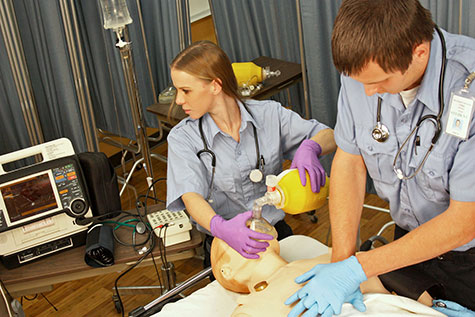
Students learn in modern classrooms, a large skills lab, and a simulation lab.
The program includes an ambulance simulator, a real mobile ambulance, and computer-controlled patient manikins. These manikins react to the care students give. This lets students practice safely before working with real patients.
Instructors record training sessions on video. Then they review the videos with students to help them improve.
Outside, EMS students train alongside Fire Academy students. They use a multi-story training tower for rescue practice and physical training. They also use an obstacle course with rough ground, crawling spaces, and climbing walls to get ready for real EMS work.
Students practice for many types of emergencies, including:
- Mass casualty incidents
- Emergencies in homes
- Emergencies at businesses
- Highway emergencies
- Hospital emergencies
This practice helps students feel confident before they work with real patients.
Career Options
After you finish the EMT program, you can keep going in EMS or apply to the MCC Fire Academy.
EMTs can work for private ambulance companies or public emergency service agencies.
Paramedics work in hospital emergency rooms, ambulances, and air medical programs, under the supervision of an emergency physician.
EMS graduates can also serve their communities as volunteers or first responders. MCC EMS and Paramedicine graduates are in high demand, and many find jobs with local employers right after they finish the program.
Your Path From EMT to Paramedic
Most students start with the Emergency Medical Technician (EMT) program. After you finish and pass the National Registry exam, you apply for your Texas EMT certification. From there, you can start your EMT career or keep training to become a paramedic through one of these options:
| Credential | Time to Complete | When It Starts | What You Need First |
|---|---|---|---|
| EMT (Level 1 Certificate) | 1 semester | Spring, summer, or fall | None |
| Advanced EMT (AEMT) Certificate | 1 semester | January | Current Texas EMT certification |
| Paramedicine Level 2 Certificate | Ask your advisor | January | Current Texas EMT certification |
| Associate of Applied Science (AAS) in Paramedicine | Ask your advisor | January | Current Texas EMT certification |
After you complete a paramedic pathway, you can take the National Registry exam at the paramedic level.
Why Choose MCC?
MCC has trained emergency medical workers for more than 40 years.
Classes are held at the Emergency Services Education Center (ESEC), which opened in 2009. It has classrooms, labs, and outdoor training areas. Students practice vehicle rescue every semester.
EMS instructors work with local emergency services and healthcare professionals. Together, they teach students using real emergency cases and realistic training exercises.
The MCC EMS/Paramedicine program is accredited by the Commission on Accreditation of Allied Health Education Programs (CAAHEP), based on the recommendation of the Committee on Accreditation of Educational Programs for the Emergency Medical Services Professions (CoAEMSP).
Commission on Accreditation of Allied Health Education Programs (CAAHEP)
- Phone: 727-210-2350
- Website: www.caahep.org
Committee on Accreditation of Educational Programs for the Emergency Medical Services Professions (CoAEMSP)
- Phone: 214-703-8445
- Website: www.coaemsp.org
Student Support
Every student gets an EMS faculty advisor. Your advisor helps you register for the right classes and answers your questions along the way.
Classes are small, with an average student-to-instructor ratio of 7 to 1. That means more one-on-one help for you.
Students complete clinical training in local hospitals and ride along with regional EMS agencies. This lets you see what the job is really like before you graduate.
How to Apply
To apply for the program, you must:
- Apply to McLennan Community College.
- Submit all required documents to Highlander Central. This includes all high school and college transcripts and your ACT, SAT, or TSI Assessment scores.
- Have a current Texas EMT certification if you are applying for the Paramedicine Level 2 Certificate or the AAS Degree.
- Complete Texas Success Initiative (TSIA) requirements if you are applying for the Level 2 Certificate or AAS Degree. You must finish any required developmental courses before the program starts.
- Meet with an EMS faculty advisor. Call Justin Lawson at 254-299-6504 or email jlawson@mclennan.edu to schedule an appointment.
- Meet all program admission requirements.